Hanging of Srebnitsky
City of GodThe Hanging of Srebnitsky is the moral fulcrum of the Kovno Ghetto testimony at the heart of E. L. Doctorow's City of God, the public execution that turns a tailor's single defiant gesture into a martyrdom the ghetto is forced to witness. It is the event that strips away every pretense of the ghetto's negotiated survival, exposes the terrible logic by which the council accommodates disaster, and forges the ten-year-old Yehoshua into the council's designated runner. The hanging also becomes the novel's deepest meditation on sacrifice, as the tailor's act is later read as a modulated, self-sacrificial defiance as deft and precise as his own tailoring, and its image of a body swinging from a gallows haunts the recovered archive that Sarah Blumenthal and Thomas Pemberton unseal decades later.
The Provocation: The Slashing of the Commandant's Uniform
The event begins not at the gallows but in the tailor's workshop on a cold, cloudy winter morning, minutes after Srebnitsky has sewn the military insignia on the shoulders and the piping on the lapels of a new uniform commissioned by S.S. Major Schmitz, the commandant and executive of all terror in the Kovno Ghetto. The young Yehoshua, who has been living under the tailor's protection as a pretend grandson, is troubled from the beginning by the enterprise, because it violates the rule to remain as anonymous as possible, to do nothing to stand out. He positions himself by the vegetable garden fence some distance down the block and watches as the commandant's black Mercedes sedan pulls up, a gleaming machine of German civilization with huge silver headlights and a chrome radiator grille, its driver rubbing away the affronts of slush and snow. When Schmitz emerges wearing his new custom-made uniform, including a rakishly blocked garrison cap, he is a portly man with wide hips, posing with his hands on his hips and a contemptuous smile. Srebnitsky follows, carrying the old uniform over his arm, and the two men share a joke about the tailor expecting to be paid, laughing heartily at the absurdity of a Jew asking for wages. Then Srebnitsky suddenly frowns, his shoulders rounding as he peers closely at something on the new uniform, his scissors in his hand. With a coy request to remove a bit of thread, he puts his hand to the commandant's chest, yanks at the lapel, and slashes the scissors-point downward across the front, so suddenly that a big flap of the ruined tunic hangs down to the officer's knee. "Sew it yourself then, thief!" the tailor shrieks. "Thief, that's what you are, that's all you are. All of you, thieves, thieves of our work, thieves of our lives!"
The major stands dumbfounded, having even cried out in fear, but his driver leaps upon the old man and clubs him to the ground with the butt of his pistol, then begins kicking him, shouting, "You dare to attack a German officer? You dare to lift your hand!" He aims his pistol at the stricken tailor and would have shot him then and there had the major not commanded him to stop. Holding his ripped tunic against his chest like a woman covering her breasts, Schmitz looks around to see who has witnessed his humiliation. Yehoshua, having turned his back, disappears into the alley between two houses, and from the shadows he watches the car flash by and listens to the fading sound of the motor before running back to find Srebnitsky lying in the snow where he had fallen, his head wounded.
The Council's Calculus and the Order for the Gallows
Sometime in the afternoon, a German soldier on a motorcycle arrives with a written order that the council immediately provide carpenters to construct a gallows in the town square leading to the bridge. Dr. Koenig, the council's leader, is able to reach the commandant by phone and is told that all Jews are to be in the square at dawn to witness the hanging of the tailor Srebnitsky. To everyone but Yehoshua, this comes as a great relief, a resolution of the crisis that had threatened the ghetto's precarious existence. The council staff then considers calmly what to do with the boy, and from a search through the records they determine that no family is available with a dead child whose identity he could assume. Mr. Barbanel, the second in charge and by far the youngest member of the council, a thickset man of about thirty-five with a thatch of black hair and a Slavic ski nose, walks over to where Yehoshua sits on a bench and squats in front of him. "So Yehoshua X, man of mystery, secret agent, are you ready for your next assignment?" he asks, and with no further ceremony he plops a garrison cap on the boy's head, placing him under the wing of the council itself as a designated runner, known to all as Yehoshua, with no last name and no identity card for his protection.
Yehoshua's child's heart, wretched with its own guilt, cannot understand the calmness with which Dr. Koenig and everyone else accommodates the disaster that has overtaken Srebnitsky and lets it run its course. He reflects later that this calmness was first of all the characteristic of doctors, who are familiars of death and composed in its presence, for Sigmund Koenig was after all a physician. Beyond that, it comes of a capacity to respond with pragmatic realism to experiences that are surreal, a capacity given to adults but not usually to children. The council's role was not morally ambivalent, for every extra ration they argued for or relaxation of rule they paid for with a concession, a brutal calculus of bodies and work and food and fuel and health and sickness. Yet in the ten-year-old's heart, it seemed that everyone was quite ready to let the disaster run its course, and this ambiguity would later vanish as he himself became connected to the administration as a runner and absorbed himself in the drama of his duties.
The Dawn Execution in the Town Square
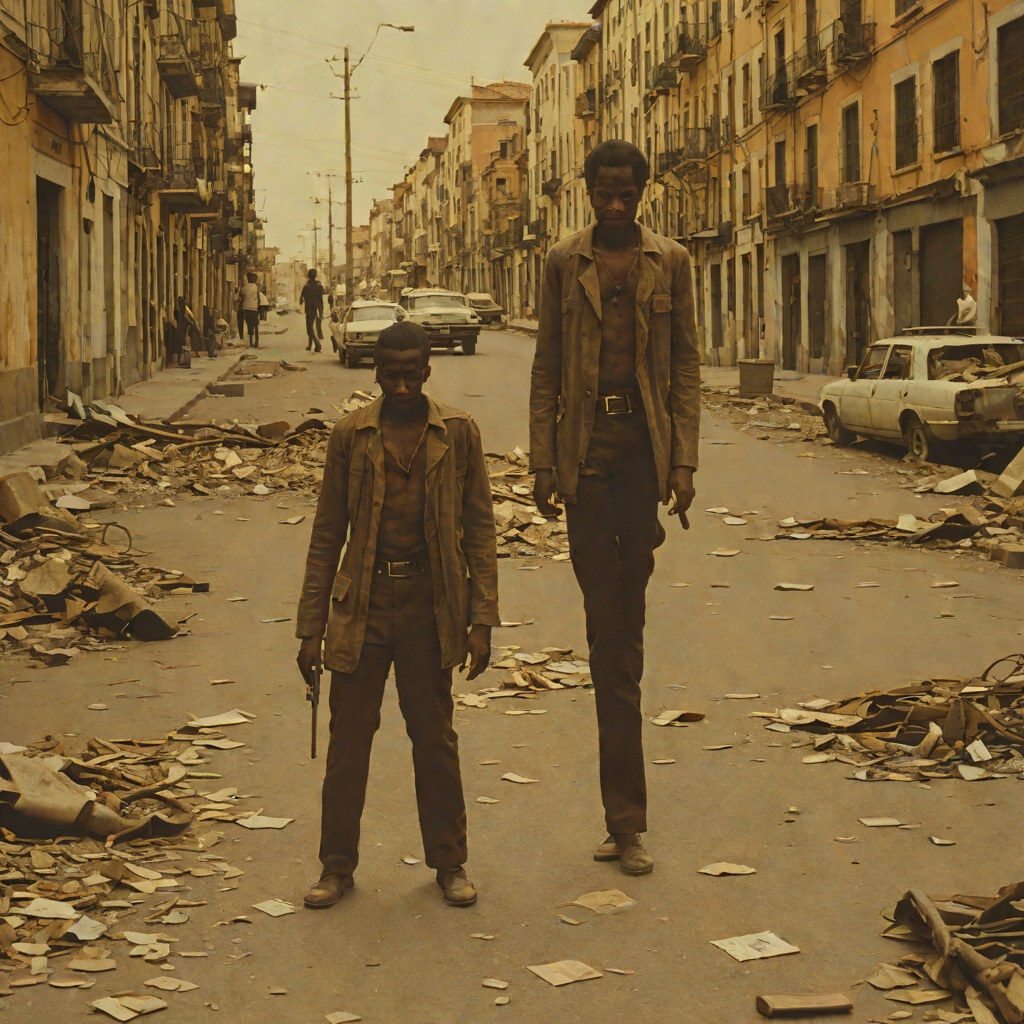
At dawn the Germans light the square with their guardhouse floodlights and the headlights of their trucks. Enough of the citizenry are gathered, perhaps a thousand, perhaps fifteen hundred, to fill the square and satisfy the authorities, with absolute silence but for the idling engines of the trucks. Prominently in attendance are Schmitz and his staff, officials of the Lithuanian police, the mayor of the city, and assorted soldiers. Mr. Barbanel has suggested that it might be better for Yehoshua to stay back in the dormitory until the whole thing is over, but the boy chooses not to, working his way through the crowd until he is off to the side quite near the scaffold. When they bring out the tailor, he is draped over the shoulders of two Jewish ghetto policemen and already half dead, his feet dragging, his legs apparently broken. They lift him up the steps to the platform and hold him propped under the arms while another policeman ties his hands behind him and slips the noose over his head. His hands, those slender deft instruments Yehoshua had admired, are mangled protuberances covered with dried blood.
At the last moment before they kick away the stand under his feet, Srebnitsky seems to come out of his agonized stupor. He lifts his head and, of this Yehoshua is sure, sees the scene before him clearly and, appreciating its magnitude, reads his glory into it. A mad triumphant light flashes from the tailor's eyes before the stand is kicked from under him and his frail body swings from the neck. There is no movement from him, no struggle, the life gone from him almost instantly. The officials from the city get into their cars and drive off, the soldiers disperse, the work details gather in their ranks and pass through the gate and begin their trek across the bridge. An S.S. man hangs a crudely lettered sign around the corpse's neck: This Jew dared to raise his hand against a German officer. The light begins to appear at last in the sky, and Yehoshua lingers in the square, sitting for a while with his back against the platform, having wanted Srebnitsky to see that he hadn't forgotten him.
The Aftermath: The Rabbi's Martyrdom and the Meaning of the Act
The Germans had ordered that the body be left hanging on public display for twenty-four hours, and an Orthodox rabbi finds this an intolerable impiety. He comes to the council office and demands that something be done about it, and Mr. Barbanel loses his temper. "An impiety!" he shouts. "Tell me, what isn't an impiety! To have murdered him, what was that—you have another word for that?" The rabbi turns on his heels and runs off, going to the square along with another man, a helper who carries a white shroud. They climb the platform and are in the act of cutting down the body when a German guard raises his carbine and shoots them both dead. The double murder of the rabbi and his helper extends the atrocity beyond the tailor himself, confirming that the Germans will kill even those who seek only to honor the dead with a proper burial.
Yehoshua, reflecting on the event years later, concludes that Srebnitsky had it in his power with his scissors to stab the commandant, and for a moment he thought the tailor had done just that, so great was his rage. But he has since concluded that Srebnitsky must have understood the disaster that would befall the ghetto were he to kill the man. What he accomplished was specifically self-sacrificial, a modulated act of defiance as deft and precise as his tailoring. The tailor's experience was not exceptional in any way, for anyone could be driven to the point of forswearing life, but in cases like Srebnitsky's it was not the simple desire to die, it was the desire for self-transcendence which once realized brings one to the end of life. That is something different, not the same thing at all. Yet what lingers in Yehoshua's mind of this cantankerous old man, this iconoclast, this embittered soul, is that he let out the boy's clothes as he outgrew them and saw to it that he got a new pair of shoes when the old ones no longer fit.
The Hanging in the Archive and the Novel's Memory
The hanging becomes one of the forbidden images preserved in the ghetto's secret archive, the documentation that Josef Barbanel, the historian by necessity, accumulates in his diary and in the chest that survives the destruction of the ghetto. When the chest is finally opened decades later in a small office in the International Arrivals Building at JFK Airport, with Sarah Blumenthal, Pem, a young woman from the U.S. Attorney's office, and various customs people watching, the inspectors unwrap packages of various sizes wrapped in oilskin to find sheaves of paper bound in twine, booklets, manuals, folders, rolled-up blueprints, diagrams, stapled documents, and envelopes of various sizes, each labeled in a small, neat Yiddish script. Among the forbidden little black-and-white photos that Pem hands to Sarah is the image of a body in a business suit hanging from a gallows, the head awry, staring heavenward, with winter snow on the ground. The photograph, like the hanging itself, becomes part of the novel's insistence that the dead are not to be consigned to anonymous oblivion, that the act of recording is itself a moral imperative against erasure. The tailor's defiance, the rabbi's martyrdom, and the archive that preserves their memory together form the novel's answer to the theological crisis Pem articulates in his final act as a Christian priest, when he speaks of the monstrously evil mortifiers of humanity and the exponential murder of souls consigned by their very numbers to the lists of anonymous oblivion. Srebnitsky's hanging is the novel's proof that even in the face of such oblivion, a single defiant act can be recorded, remembered, and read as glory.